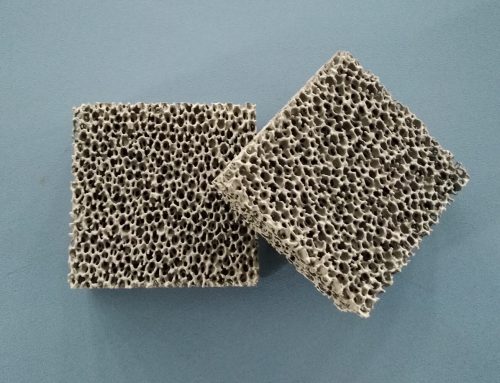
Titanium foam has become a research hotspot in metallic foam materials in recent years. Current studies on titanium foam mainly focus on biomedical and aerospace fields. With further research, titanium foam has been found to exhibit excellent properties such as low density, high strength, strong corrosion resistance, excellent energy absorption, effective thermal and sound insulation, and noise reduction. These properties not only give it promising applications in traditional fields of titanium and titanium alloys but also broaden its prospects in filtration and separation, fluid distribution and control, crash and vibration protection, thermal insulation, noise absorption, porous electrodes, and biomedical implants.
1.Traditional Application Fields
In traditional fields, titanium foam is generally used to manufacture sports equipment (such as sleds), ship hulls, automotive body and interior components, and aerospace parts.
2.Filtration and Separation
Due to its high porosity, high-temperature resistance, chemical stability, acid/alkali corrosion resistance, and oxidation resistance, titanium foam is used in:
- Decarbonization filtration and terminal safety filtration in the pharmaceutical industry,
- Impurity removal during raw material production in drug manufacturing,
- Filtration in water treatment industries,
- Clarification filtration in food and beverage industries,
- Decarbonization filtration, precision filtration, and impurity removal in the chemical industry,
- Filtration of reinjection water in oilfields,
- Gas purification filtration.
3. Fluid Distribution and Control
Titanium foam is widely used as a fluid distribution device, such as aerating beer, evenly introducing oxygen into blood in medical oxygenation, and acting as a signal delay device in liquid, gas, or vacuum systems. It is also used as a signal control delayer in automation systems.
4. Crash and Vibration Protection
Titanium foam typically has high porosity and a unique isotropic porous network structure, giving it special compressive stress-strain characteristics. Depending on density, its energy absorption capacity ranges from 490–3,430 kJ/m³, making it an effective material for crash and vibration protection. Applications include buffers, vibration absorbers, spacecraft landing gear, elevator safety pads, and automotive side/front crash components.
5. Thermal Insulation
Titanium foam has a unique structure, with thermal conductivity between solid titanium and insulating materials (approximately 0.1–0.01 times that of metals/alloys). Closed-cell structures offer better insulation than open-cell ones, and higher porosity improves thermal insulation. In construction, titanium foam’s lightweight, heat-resistant, and non-flammable properties make it suitable for indoor/outdoor decoration and ceiling materials.
6. Noise Reduction
Compared to other materials, titanium foam offers advantages such as ultra-light weight, high-temperature resistance, strength, moisture resistance, pollution resistance, and recyclability. It is used to produce eco-friendly sound-absorbing materials, including industrial noise reduction devices, air compressor silencers (effective for 800Hz noise), mechanical sound barriers, acoustic rooms, and military applications like torpedo noise-reducing panels.
7. Biomedical Implants
Titanium foam’s high porosity and connectivity allow it to provide nutrients for bone tissue growth and enhance implant-bone integration through biological fixation. By adjusting porosity and pore size, its Young’s modulus can match human bone, shortening patient recovery. Common titanium foam alloys include TiNi, TC4, and TiTa. TiNi foam, with its shape memory effect, pseudoelasticity, biocompatibility, and mechanical strength, is an excellent bone substitute for repairing defects and reducing implantation discomfort.