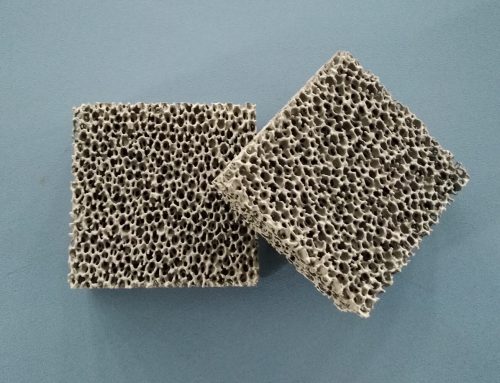
Foam ceramics are the third generation of porous ceramic products, developed after ordinary porous ceramics and honeycomb porous ceramics. They feature a foam-like porous shape with three-dimensional interconnected channels. Their shape, pore size, specific surface area, permeability, and chemical properties can be adjusted through various processes, making the products resemble “tempered foam plastics” or “ceramicized sponges.”
Generally, foam ceramics are divided into two types based on whether each pore has a solid wall: open-cell (reticulated) ceramics and closed-cell ceramics. If the solid forming the foam body is contained only within the pore edges, and the pores are interconnected, it’s called an open-cell ceramic material. If there’s a solid wall and the pores are separated by a continuous ceramic matrix, the foam body is called a closed-cell ceramic material. However, most foam ceramics have both open and a small number of closed pores.
Based on pore size, foamed ceramics can also be classified as:
- Microporous ceramics: Pore size less than 2 nanometers
- Mesoporous ceramics: Pore size between 2 and 50 nanometers
- Macroporous ceramics: Pore size greater than 50 nanometers
As a new type of porous ceramic material with a three-dimensional reticulated structure, foam ceramics possess numerous exceptional characteristics. They boast low bulk density, high porosity, large specific surface area, and excellent permeability. Their high strength, superior sound and thermal insulation, and strong resistance to high temperatures and acid-alkali corrosion make them incredibly versatile. Furthermore, they exhibit low thermal conductivity, excellent thermal shock resistance, stable chemical properties, minimal gas pressure loss, and effective filtration and adsorption. These materials also display outstanding electrical, magnetic, and optical properties, along with a long lifespan and simple regeneration.
These myriad qualities have led to their widespread application in various fields, including metallurgy, chemical engineering, aerospace, automotive, electronics, and medicine. Foam ceramics can serve as insulation materials, insulating and anti-seepage materials, thermal and acoustic insulation materials, special fillers, sound-absorbing materials, catalysts and catalyst carriers, molten metal and hot gas filters, automotive exhaust purifiers, porous media burners, separation membranes, heat exchangers, fuel cell electrodes and diaphragms, sensors, thermistors, and porous piezoelectric ceramics, offering broad application prospects.