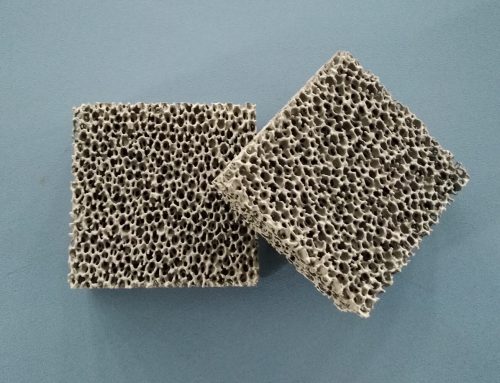
The filtration mechanism of foam ceramics is generally described as a combination of diffusion interception, inertial impaction interception, or screening, deposition, and deep bed filtration. A national key laboratory at Tsinghua University has established 3D physical models and two-phase flow models for the filtration mechanism of foam ceramics and performed simulation calculations. This is very helpful for our research into the filtration and purification of aluminum liquid. However, the filtration and purification process of aluminum liquid by foam ceramics is very complex, involving high-temperature physical chemistry and metallurgical kinetics.
While screening, impaction, settling, and interception filtration are relatively easy to understand, our comprehensive analysis of various parameters obtained during the study of foam ceramic filtration has led to the following insights:
1.Mechanical Filtration (Screening, Inertial Impaction, Diffusion Interception, Friction, and Settling): The filtration efficiency is directly proportional to the mesh aperture of the foam ceramic. Smaller mesh sizes lead to a stronger ability to intercept smaller particles.
2.Deposition Layer or Filter Cake Effect: As particles in the melt deposit onto the tortuous, interconnected, and uneven skeletal struts of the foam, the capture capability for impurity phase particles is enhanced.
3.Rough Surface Effect: The rough surfaces formed by gaps or unglazed areas on the skeletal struts increase the interfacial energy between the aluminum liquid flow and the ceramic solid surface. This promotes a more disordered flow of particles within the aluminum liquid, which is beneficial for the capture and deposition of solid impurity phase particles.
4.Chemical Adsorption and Enhanced Filter Cake Effect: Microcracks and pinholes on the surface of the skeletal struts can pre-deposit fluorides that have a strong affinity for particles like Al₂O₃. This promotes a more complete filter cake effect and strong chemical adsorption, significantly enhancing the ability to capture and retain impurity phase particles.
5.Re-distribution and Re-integration of Alloy Solutes and Impurity Growth: Due to the temperature field effect during the melting and transfer processes within the molten metal structure, concentration differences of alloy solutes are inevitably formed. The molten metal undergoes continuous redistribution-integration-redistribution-reintegration. This also serves as an excellent alloying treatment process, where some high-melting-point metal phases and compounds re-aggregate and grow. The aggregation and growth of fine impurity phases are beneficial for filtration and capture. This can also be illustrated by the changes in concentrations of H, Al₂O₃, Fe phase, and Ti phase in the aluminum liquid before and after filtration, especially evident in two-stage or multi-stage filtration.
Therefore, under the same preconditions, novel foam ceramic filter plates exhibit a higher removal rate of impurity phases in aluminum melts, and the change in static pressure difference over time before and after filtration is significant. Naturally, selecting foam ceramic filter plates with smaller pore sizes will improve the filtration precision of aluminum melts.