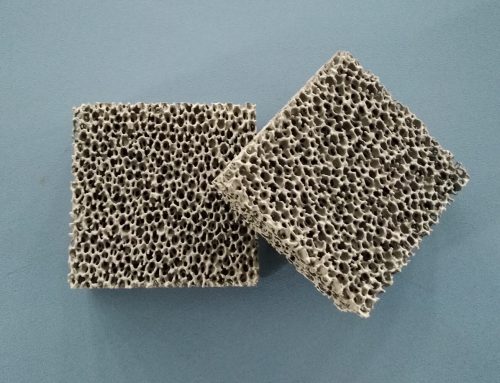
Foam Aluminum (FA), as a new type of material that combines lightweighting, porous structure, and multi-functional properties, shows broad prospects in the field of modern green building, especially in the application of high-performance Curtain Walls. Foam Aluminum is one of the key technologies for achieving modern green and ultra-low energy consumption building curtain walls. Its unique energy absorption mechanism is a core competitive advantage; Foam Aluminum with a porosity of 70% can achieve 60% to 80% impact energy dissipation when subjected to impact loads. This capability greatly enhances the building’s buffering capacity and safety under extreme wind pressure and potential impacts. In terms of thermal performance, the thermal conductivity of closed-cell Foam Aluminum can be as low as 0.1 to 0.5 W/(m·K), effectively meeting the increasingly high energy-saving requirements for current building envelope structures.
Challenges Faced by Modern High-Performance Curtain Walls
With the increasing stringency of global standards for green buildings and ultra-low energy consumption buildings, modern high-performance curtain walls face multiple technical challenges. Firstly, the heat transfer coefficient (U-value) must be compulsorily reduced to decrease building energy consumption; secondly, urbanization and climate change require curtain walls to possess higher wind pressure resistance and seismic performance to cope with extreme weather; finally, the escalating urban noise pollution places higher demands on the acoustic performance of the envelope structure. Furthermore, for super-tall buildings and the increasingly popular prefabricated buildings, achieving lightweighting of the curtain wall system is paramount, as this not only reduces the load on the main structure but also optimizes transportation and installation efficiency.
Definition, Structural Characteristics, and Positioning of Foam Aluminum (FA) in Green Building
Foam Aluminum is a new type of porous lightweight material manufactured by introducing a large number of pores into an aluminum matrix. Due to its unique structure, FA combines lightweighting, porous structure, and multi-functional properties, and is positioned as a core material in the “Carbon Neutral” building strategy. In building curtain walls, Foam Aluminum is primarily used as the core layer of Foam Aluminum Sandwich Panels (FASP). This structure utilizes the FA core layer to achieve high strength, sound insulation, thermal insulation, and flame retardancy, and is bonded with the face sheets to form an integrated unit, thereby significantly improving the safety and living comfort of the building.
Traditional building materials, such as rock wool or ordinary acoustic panels, usually offer only a single function. The emergence of Foam Aluminum breaks this limitation, as it can integrate thermal insulation, sound absorption, lightweighting, and high-strength energy absorption into a single material. This functional integration feature greatly simplifies the architectural design, reduces the number of layers and the total weight of the curtain wall system, and simultaneously enhances structural redundancy. This integrated advantage makes FA particularly suitable for sustainable development applications in temporary construction and post-disaster emergency scenarios that require rapid construction and high functional compounding.