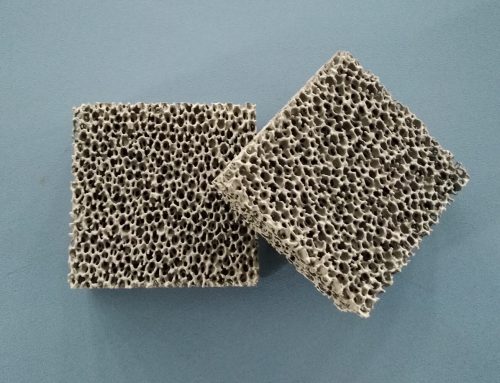
The application of aluminum foam in the fields of impact energy absorption and crash safety is its most significant value proposition. As a lightweight, highly efficient energy-absorbing material, it can dramatically improve vehicle safety performance during collisions.
The unique advantage of aluminum foam lies in its porous structure, which results in a long “plateau stress” stage when compressed. This means it can absorb massive amounts of energy under a nearly constant force. This characteristic is crucial for crash safety.
Primary Applications of Aluminum Foam in Crash Safety
1. Crash Boxes and Bumpers
This is one of the earliest and most typical applications of aluminum foam in automobiles.
- Mechanism: Aluminum foam is filled into the front or rear crash boxes (typically hollow extrusions made of aluminum alloy or steel).
- Safety Advantage: During low-speed collisions (such as rear-end traffic incidents), the foam-filled crash box undergoes controlled plastic deformation and foam collapse, absorbing the vast majority of the impact energy.
- Performance Improvement: Compared to hollow crash boxes, aluminum foam filling can increase the energy absorption capacity by 4 to 5 times. It also stabilizes the force-displacement curve during absorption, effectively preventing deformation of the main vehicle structure and reducing repair costs. It further enhances efficiency by preventing or reducing the local buckling of the hollow tube, guiding it toward a more efficient folding mechanism.
2. Filling of Body Structure Components
Aluminum foam is often used as a filler material to reinforce the hollow structural components of a vehicle’s body-in-white (BIW).
- Filling Locations: Primarily includes key structural parts like the front/rear longitudinal members, A- and B-pillars, door beams, and chassis cross-members.
- Safety Advantage: Filling these hollow structures with aluminum foam significantly increases their stiffness and load-bearing capacity, preventing premature instability or local failure during high-speed collisions. This protects the integrity of the passenger cabin and ensures occupant survival space.
- Composite Energy Absorption: The aluminum foam works synergistically with the external metal tube wall, forming a composite energy absorption structure whose total absorption effect is greater than the sum of the two components absorbing energy individually.
3. Energy Absorption Enhancement in Specific Areas
- Seat Cross-members: Filling the seat cross-member with an aluminum foam composite structure can greatly improve its bending and compression performance, offering stronger support and protection during a side-impact accident.
- Battery Pack Protection (for EVs): Aluminum foam can serve as a buffer material for battery pack structures. It absorbs impact energy during bottom or side collisions, thus protecting the internal battery cells.
It is due to these characteristics that aluminum foam has become a critical material in modern automotive design, meeting the increasingly stringent demands for both crash safety and lightweight construction.